Canada

The publishing landscape is constantly evolving. At Newprint we’ve compiled 20 important book sales statistics that offer a revealing snapshot of today’s reading and publishing habits.
Whether you’re an author, publisher, or curious reader, understanding who’s reading, what formats are trending, and how the global market is shifting is key. From trending formats to bestselling new books, the data paints a clear picture. And if you're considering turning your manuscript into a physical product, professional book printing services make it easier than ever to bring your vision to life.
Let’s explore what the latest numbers reveal about the industry.
Book Sales Statistics - General Reading and Book Consumption Trends
Who is reading, how often, and in what format?
1. 54% of Americans read or listened to a book in the past year (source)
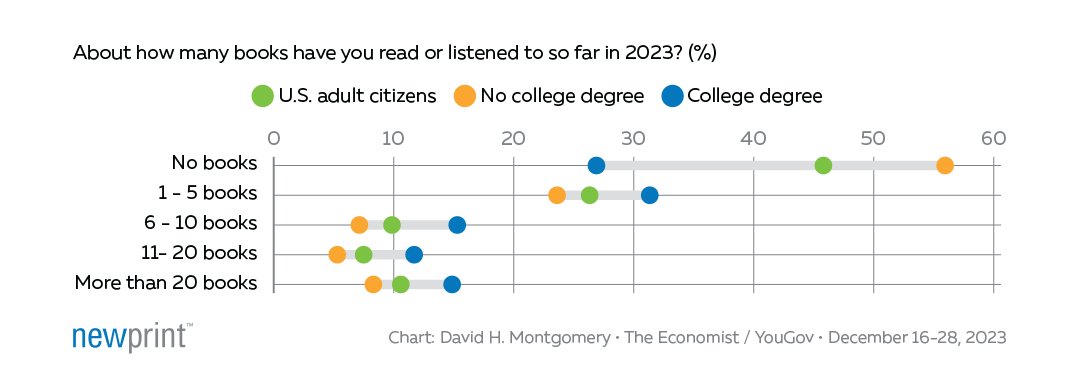
According to the most recent study from 2023, more than half of U.S. adults read at least one book over the past 12 months. About 18% read more than 10 books over that same time period, and 1% read more than 50.
Broken down by educational attainment, 73% of Americans with a college degree read or listened to at least one book while 44% of those without a college degree did the same.
2. 42% of American adults read a printed book in the past year, down from 65% just 5 years earlier (source and source)

Among adult American readers, physical books are still more popular than ebooks and audiobooks, but that popularity has decreased over the past few years.
The most recent data shows that among adult U.S. citizens who read a book in 2023, about 42% read at least one physical book, while 21% read a digital book and 19% listened to an audiobook on platforms like Audible or Scribd. To highlight a declining trend, a 2018 study found that 65% of Americans read at least one physical book in the past 12 months.
Gender
Printed books remained slightly more popular among women than men, as 44% of women read a physical book that year versus 41% of men. Digital books (21%) and audiobooks (19%) were equally popular among men and women.
Age
Younger adults represent a large segment of readers. About 26.2% of readers were between the ages of 25 and 34.
Educational Attainment
However, printed books were significantly more popular among Americans with a college degree than among those without, with 60% of college graduates reading a physical book that year compared to 33% of Americans without a college degree.
The survey indicates all forms of reading were more popular among the college educated population than among those without a college degree, with 34% versus 15% reading a digital book and 31% versus 13% listening to an audiobook.
Income Level
Approximately 34.5% of readers were in the high income bracket of the population.
3. About 51% of American adults read a printed book or ebook in the past month (source)
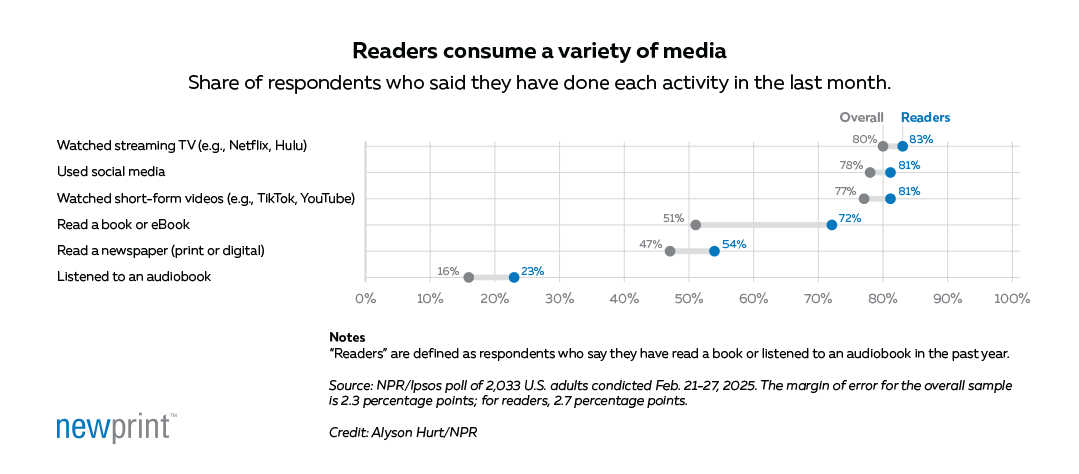
The February 2025 survey also found that the percentage of respondents who identified as “readers” were even more likely to pick up a book—about 72% of them reported reading a printed book or ebook in the past month.
Book Sales Statistics - Total Market Size and Industry Revenue
Industry-wide book sales, revenue, and growth.
4. Global books market revenue will reach $142.72 billion in 2025 (source)

The market size is projected to grow to $156.04 billion in 2030 at a compound annual growth rate (CAGR) of 1.8%.
- Largest market - Asia Pacific
- Fastest growing markets - Middle East and Africa
- Major players in publishing - MacMillan Publishers, Pearson, Penguin Random House, Harper Collins Publishers, and Hachette Livre
4. Global books market revenue will reach $142.72 billion in 2025 (source)
5. The U.S. book publishing industry is projected to have an annual net revenue of $24.77 billion in 2025 (source)
Annual book sales revenue has decreased nationwide in recent years, following a period of apparent market stabilization at $28.1 billion in 2022. However, revenue is projected to grow to $27.59 billion by 2030 at a CAGR of 2.18%
6. Global online book sales will reach $26.04 billion in 2025—and nearly double over the next decade (source)

Book sales statistics indicate the online books market size will grow from $24.31 billion in 2024 and expand to $48.27 billion by 2034 at a CAGR of 7.1%.
7. The number of bookstores in the U.S. is growing—with $23.4 billion in projected revenue for 2024 (source)
Bookstore market revenue is expected to continue to grow, reaching $27.25 billion by 2029 at a CAGR of 3.1%. Meanwhile, there were a projected 43,100 bookstores nationwide in 2023, at an increase of 0.5% over the previous year. This represents a workforce of about 218,165 employees earning wages totaling approximately $4.2 billion.
8. By 2030, about 151.8 million Americans will be reading books (source)
This is an increase from a projected 141 million readers in July 2025, representing a user penetration of 42.1%.
9. In 2025, the average American reader generates $145.75 in book sales annually (source)
This is the estimated nationwide average revenue per user (ARPU).
Format-Specific Book Sales - Print, Ebook, Audiobook
Book sales statistics and trends by format, looking primarily at sales figures but also adoption of new technology.
10. In the U.S., printed book sales totaled 782 million in 2024—a 23% increase over the past decade (source)
Not only is print still popular, but print sales also grew by nearly one-fourth from 2014 to 2024. This includes both paperback and hardcover, sold through brick-and-mortar retailers as well as online retailers like Amazon.
11. Audiobook sales reached $1.8 billion in annual revenue (source)
The latest data for this figure, also from 2022, shows a growing market share for the book format after increasing consistently since 2018.
12. Global ebook sales are projected to reach $14.92 billion in 2025 (source)
This market volume is projected to increase to $15.87 billion by 2030 at a CAGR of 1.24%. Estimates predict ebook sales in the U.S. will generate $5.38 billion in 2025, making it the largest market for digital book sales.
13. An estimated 13.7% of the global population will use ebooks by the end of 2025 (source)
Ebook user penetration is expected to increase to 14.6% by 2030, when there will be a projected 1.2 billion ebook users worldwide. This surging popularity is partly attributed to users seeking the convenience offered by digital media on platforms like Kindle and Nook. Particularly in the U.S., ebook sales skyrocketed between 2019 and 2020, likely influenced by the COVID-19 pandemic.
14. In 2025, the average ebook user will generate about $13.97 in retail sales (source)
This represents the average revenue per user (ARPU).
Book Sales Statistics by Title and Category
Top-selling books by genre and individual performance.
15. The best-selling book of 2024 was The Women by Kristin Hannah, with 1.5 million books sold (source)
Here’s the top 10 bestseller list from last year, based on a ranking of unit sales.
- The Women, Kristin Hannah - 1.5 million
- A Court of Thorns and Roses, Sarah J. Maas - 1.3 million
- The Scarlet Shedder (Dog Man #12), Dav Pilkey - 1.25 million
- The Housemaid, Freida McFadden - 1.1 million
- Atomic Habits, James Clear - 982,000
- It Ends with Us, Colleen Hoover - 931,000
- Iron Flame, Rebecca Yarros - 877,000
- Fourth Wing, Rebecca Yarros - 810,000
- A Court of Mist and Fury, Sarah J. Maas - 791,000
- It Starts with Us, Colleen Hoover - 757,000
The success of new books like The Women and Dog Man #12 highlights the growing demand for fresh stories in both adult and children’s literature.
16. In 2024, religious presses saw 18.9% growth in net book sales while adult fiction generated the highest sales revenue at $3.26 billion (source)
According to Publishers Weekly, the following types of books saw the highest growth in book sales figures from December 2023 to December 2024, ranked by performance:
- Religious Presses - Sales increased 18.9% to $909.2 million.
- Adult Fiction - Sales rose 12.6% to $3.26 billion.
- Adult Nonfiction - Sales up 1.3% to $2.88 billion.
- Children’s/Young Adult Fiction - Sales down 0.3% to $1.99 billion.
- Children’s/Young Adult Nonfiction - Sales fell 0.9% to $433.5 million.
- Higher Education Materials - Sales increased 6.7%.
- University Presses - Sales rose 6%.
- Professional Books - Sales declined 0.5%.
- PreK-Instructional Materials - No data available.
17. Harry Potter is the best-selling book series, with about 500 million copies sold (source)
Here are the nine top series ranked by total book sales statistics:
- Harry Potter - 500 million
- Goosebumps - 350 million
- Perry Mason - 300 million
- Berenstain Bears - 260 million
- Choose Your Own Adventure - 250 million
- Sweetvalley High - 250 million
- Nancy Drew - 200 million
- Robert Langdon - 200 million
- Diary of a Wimpy Kid - 200 million
18. The Bible is the best-selling individual book (5 billion sold), and Don Quixote is the best-selling novel (500 million sold) (source)
Based on total copies sold, the 15 best-selling individual books are:
- The Bible - 5 billion
- The Quran - 3 billion
- The Little Red Book: Quotations from Chairman Mao - 900 million
- Don Quixote - 500 million
- Selected Articles of Chairman Mao - 450 million
- A Tale of Two Cities - 200 million
- The Lord of the Rings - 150 million
- Scouting for Boys: An Instruction in Good Citizenship - 150 million
- The Book of Mormon - 150 million
- The Little Prince - 140 million
- Harry Potter and the Sorcerer’s Stone - 120 million
- The Truth that Leads to Eternal Life - 107 million
- Alice in Wonderland - 100 million
- Dream of the Red Chamber - 100 million
- The Lion, The Witch and the Wardrobe - 85 million
Book Sales Statistics for Writers - Author Revenue and Publishing Realities
Useful for aspiring authors and publishing professionals.
19. For traditionally published authors, the average sales revenue is $1 to $1.50 per book sold (source)
In traditional publishing, most of the book’s revenue is retained by the publisher, as they also cover most of the costs related to publication. By contrast, self-published authors keep 35% to 75% of revenue but are also responsible for managing or outsourcing editing, cover design and illustration, marketing, printing, distribution, and other vital tasks that are typically necessary for self-published books to have a stronger chance of success.
20. About 96% of books sell fewer than 1,000 copies, and only 0.01% of books sell more than 100,000 copies (source)
According to data gathered by Bookstat, writers hoping for bestsellers have some significant odds to overcome. Only about 4% of books surpass 1,000 total sales, and one in 10,000 books will break 100,000.
What These Book Sales Statistics Reveal
The 2025 book sales data highlights several key industry trends that reflect changing consumer habits and emerging opportunities for authors and publishers alike. Here are key takeaways the book sales statistics reveal:
- Reading remains strong: Over half of American adults report reading or listening to books annually, with monthly engagement also high.
- Print still matters: Despite the rise of digital formats, print book sales in the U.S. totaled 782 million in 2024, growing 23% over the past decade.
- Audiobooks and ebooks are on the rise: Audiobooks reached $1.8 billion in revenue, while ebooks are projected to hit $14.92 billion globally in 2025.
- Bookstores are growing: With $23.4 billion in projected revenue for 2024 and over 43,000 locations, physical stores remain vital to the book ecosystem.
- Online sales are booming: Global online book sales are set to nearly double by 2034.
- The U.S. leads the market: It will generate $24.77 billion in book revenue in 2025—the most of any country.
- Publishing remains a challenge for writers: Only 0.01% of books sell more than 100,000 copies, underscoring how competitive the industry is.
- Genre matters: Adult fiction leads in revenue, while religious books saw the highest year-over-year growth.
The data underscores one central truth: while formats evolve, the love of books—and the business around them—is stronger than ever.
How Newprint Can Help
Whether you’re publishing a novel, children’s book, school book, catalog, planner, or manual, Newprint will help you turn your project into a beautifully bound product. We offer everything you need for professional-grade book printing. Simply upload your PDF, choose your book type, select your specs, customize the design, and get real-time pricing so you stay within your budget.
Newprint also offers product packaging, labels, mail services, envelopes, trading cards, and more. Whatever you’re printing, we can make publishing easy, professional, and efficient.
Contact us to get started today.